How to Manage Multiple Villas Without Spreadsheets and WhatsApp
When bookings, staff tasks and owner reports live in separate places, growing a villa portfolio means more coordination. Here’s what a connected operation can look like.
A manager should be able to check tomorrow’s arrivals without piecing together a reservation spreadsheet, a guest chat and a housekeeping message. Managing more villas gets harder when every answer requires someone to assemble the picture first.
Managing one villa is different from managing twenty
Spreadsheets and WhatsApp can work well when the team is small and everyone knows the property. A shared calendar and a quick message may be enough to coordinate a stay.
As the portfolio grows, reservations, guest information, arrivals and departures, housekeeping, maintenance, expenses and owner reporting spread across different files and conversations. Each tool can still do its job, while the overall operational picture becomes fragmented.
The hidden cost of disconnected operations
Staff check several sources before acting. A late checkout is confirmed in chat but never reaches the person arranging cleaning. A maintenance task gets buried in messages, with no clear owner or update attached to the property.
At month end, someone re-enters booking totals and assembles expenses manually. Owners ask managers for information that should already be visible. The cost shows up as duplicate entry, repeated questions and time spent checking whether everyone has the latest version.
Before changing tools, follow one recent stay from reservation to owner statement. Write down each handoff, who is responsible and where information has to be copied. That gives you a practical starting point.
More software isn't always the answer
Adding a task app or a separate reporting dashboard can create another place to maintain. Start by deciding which record should hold each piece of information and how changes should reach the people who need them.
The goal is a connected workflow around the actual business: Booking → Operations → Financials → Owner. Existing tools can remain useful where they fit; the important part is how information moves between them.
- 1Booking
- 2Operations
- 3Financials
- 4Owner
What a connected villa operation can look like
A booking carries the property, stay dates and guest preparation details into the arrival schedule. Operations can assign preparation and housekeeping work, plan turnover after departure and keep maintenance tasks attached to the right villa.
That same booking contributes revenue to the property’s financial view. Expenses recorded against the property can be reviewed alongside it, then included in owner reporting according to the management agreement. Staff, managers and owners use the same underlying information through views appropriate to their responsibilities.
Decide who can change dates, assign tasks, approve expenses and see owner figures before building these views. Connecting records only helps if responsibility and access are clear.
One booking, one connected workflow
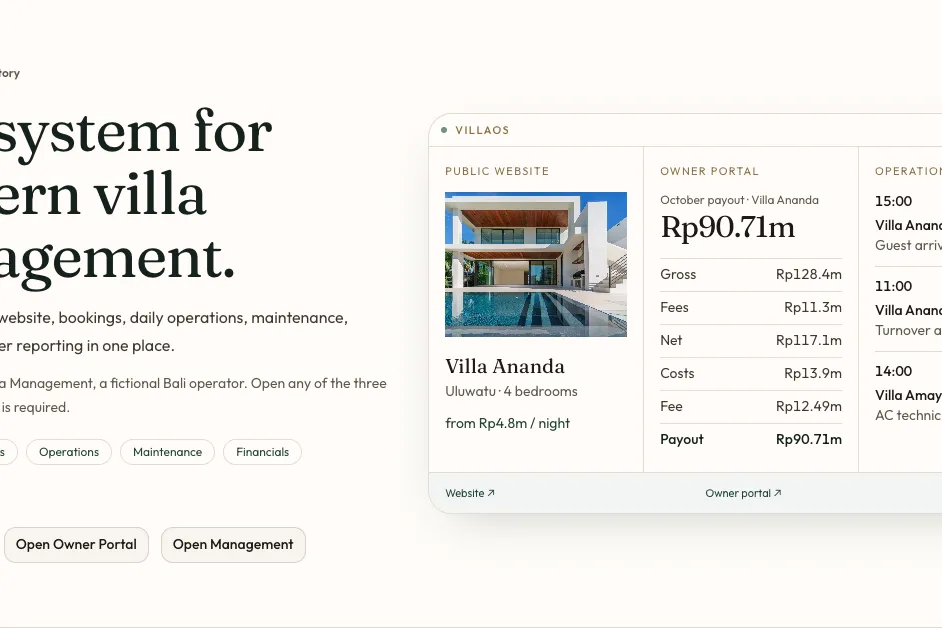
VillaOS by Fun Factory illustrates this idea with fictional properties and demo data. Consider a guest booking Villa Ananda: the booking becomes visible to operations, arrival and turnover work can be coordinated, and revenue can be viewed in the property’s monthly financial picture.
The owner portal illustrates how performance and payout information can be made visible to the owner. This is an example workflow in an interactive demonstration, rather than a claim about a real customer’s results.
Your villa business probably works differently
Property portfolios, booking channels, management agreements and owner relationships vary. So do staffing structures, financial processes and reporting requirements. A company managing a few long-stay properties may need a different workflow from a team handling frequent turnovers across twenty villas.
VillaOS isn't a one-size-fits-all PMS we're trying to sell you. It's a demonstration of what's possible when the system is designed around the operation.
Fun Factory designs and builds systems around the way your business actually works. Start with the handoffs that cause the most confusion, agree on the information each team needs, and shape the system around those decisions.