How to Connect Warehouse, Store and Customer Systems Into One Platform
A practical look at what it takes to connect warehouse, retail and customer-facing systems into one platform instead of three disconnected tools.
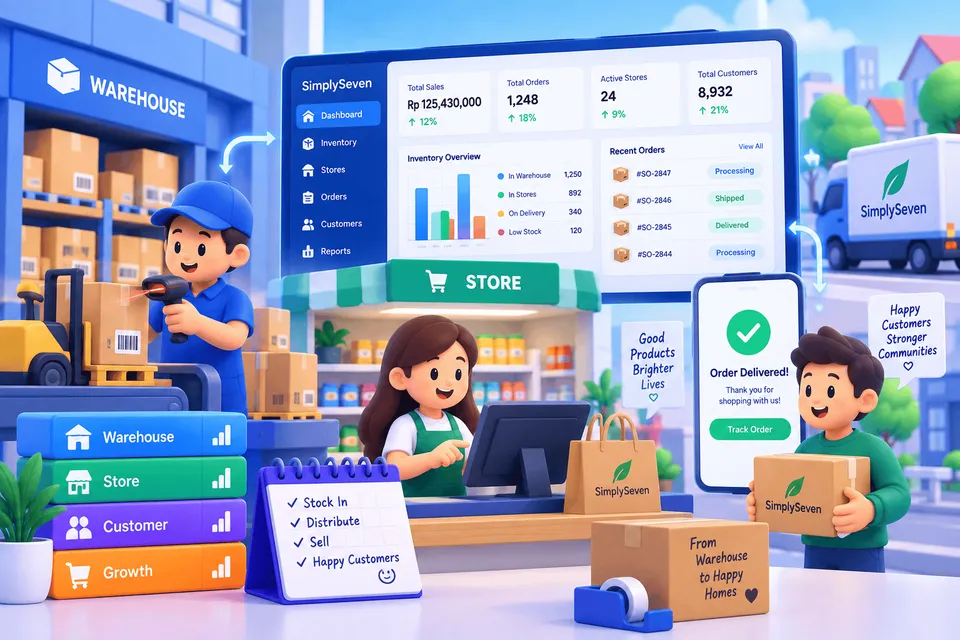
Retail and distribution businesses tend to accumulate systems one problem at a time — a warehouse tool, then a POS for stores, then a spreadsheet for reporting, then eventually a customer app bolted on separately. Individually each piece works. Together, they stop telling you the truth about your business in real time.
Where the disconnect actually shows up
The clearest symptom is a stock transfer: a warehouse team moves inventory to a store, but the store system and the warehouse system don’t agree on the number until someone reconciles them manually. Multiply that across every store and every transfer, and operational visibility becomes a spreadsheet exercise instead of a dashboard.
What "connected" actually means
A connected system means warehouse inventory, store-level stock, sales and customer activity all read from the same source of truth. Stock transfers update everywhere at once, sales and operational reporting roll up automatically, and a customer-facing app or website can safely show real inventory instead of stale numbers.
Start with the data flow, not the feature list
Before choosing or building anything, map how a single unit of inventory actually moves — from warehouse, to store, to sale, to customer — and where that information currently breaks or requires manual re-entry. Those break points are exactly where a connected platform needs to focus first.
What this looked like in practice
For SimplySeven, this meant building warehouse management, store management, inventory tracking, stock transfers, sales and operational reporting, a member mobile app and the company website as one interconnected ecosystem rather than separate projects. See the full case study for how the pieces fit together.
Frequently asked questions
Where does the disconnect between warehouse, store and customer systems actually show up? +
The clearest symptom is a stock transfer: a warehouse moves inventory to a store, but the two systems don’t agree on the number until someone reconciles it manually — multiplied across every store and every transfer.
What does a "connected" system actually mean? +
Warehouse inventory, store-level stock, sales and customer activity all read from the same source of truth, so stock transfers update everywhere at once and a customer-facing app can safely show real inventory instead of stale numbers.
Where should you start when connecting these systems? +
Map how a single unit of inventory actually moves — from warehouse, to store, to sale, to customer — and find where that information currently breaks or requires manual re-entry. Those break points are where a connected platform needs to focus first.
What did this look like in practice? +
For SimplySeven, it meant building warehouse management, store management, inventory tracking, stock transfers, sales and operational reporting, a member mobile app and the company website as one interconnected ecosystem.
More insights

Got an app, website or game in mind?
Tell us what you're building. We'll shape the right team and the right solution around your goals.
Start a project