How We’d Digitize a Restaurant, From POS to Accounting
A hypothetical system design connecting a restaurant’s POS, kitchen, inventory and accounting — illustrating the architecture, not a real client project.
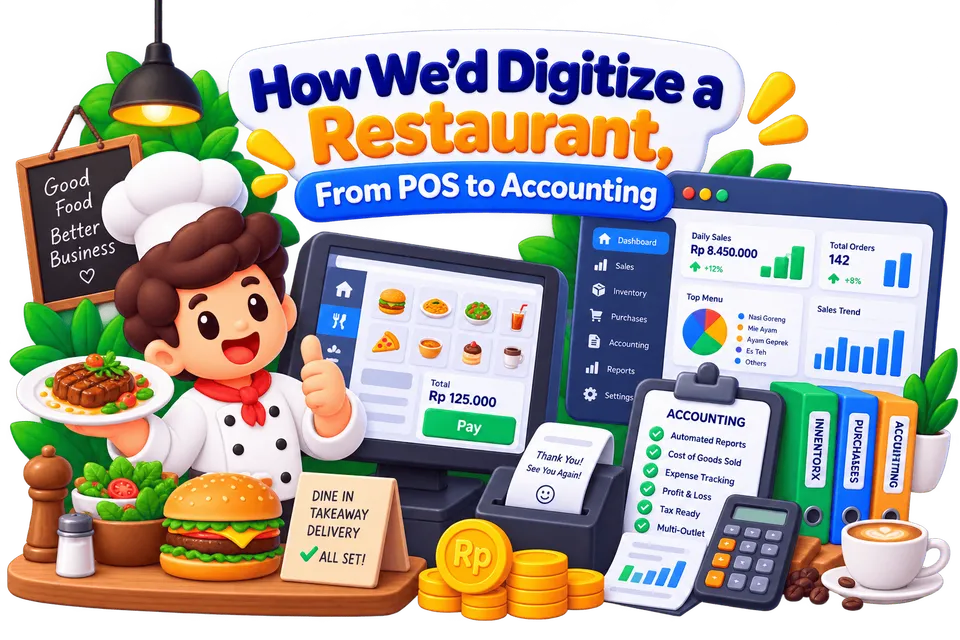
This is not a case study — it’s the system we’d actually propose if a restaurant came to us with the common complaint that its POS, kitchen and books never seem to agree with each other.
The problem
The POS records sales. The kitchen works off printed tickets. Inventory is counted by hand at the end of the week and rarely matches what the POS implies should be left. Accounting reconstructs the month from POS exports and supplier invoices, days after the fact. Each piece works in isolation; nothing agrees with anything else.
What we’d build
One flow from customer order, through the POS, to a kitchen display, deducting recipe-based inventory as items are sold, feeding purchasing when stock runs low, and rolling everything into accounting and an owner dashboard automatically. The key design decision is recipe-based deduction — inventory drops by ingredient, per dish sold, not by finished item, which is the only way recorded stock has a chance of matching actual stock.
Why inventory rarely matches reality without this
Manual stock counts capture a snapshot once a week; sales happen continuously. Waste, portion variance and staff meals never get recorded anywhere. Recipe-based tracking doesn’t eliminate all of that, but it removes the biggest source of drift — the gap between what the POS assumes was used and what a person remembers to write down.
Expected result
An owner dashboard that reflects the business in near real time instead of at month-end, inventory numbers worth trusting, and one less manual reconciliation every week. For a business running more than one outlet, the same system rolls sales and inventory up across all of them into a single view.
Frequently asked questions
Why doesn’t a restaurant’s POS, kitchen and accounting agree with each other? +
The POS records sales, the kitchen works off printed tickets, inventory is counted by hand weekly, and accounting reconstructs the month from exports and invoices days later — each piece works in isolation, so nothing agrees.
What would you actually build to fix it? +
One flow from customer order through the POS to a kitchen display, deducting recipe-based inventory as items sell, feeding purchasing when stock runs low, and rolling everything into accounting and an owner dashboard automatically.
Why is recipe-based inventory tracking the key design decision? +
Manual stock counts capture a weekly snapshot while sales happen continuously, and waste or staff meals never get recorded. Deducting stock by ingredient per dish sold removes the biggest source of drift between recorded and actual stock.
What result should a restaurant expect? +
An owner dashboard reflecting the business in near real time, inventory numbers worth trusting, one less manual reconciliation every week, and — for multiple outlets — sales and inventory rolled up into a single view.
Related reading
Got an app, website or game in mind?
Tell us what you're building. We'll shape the right team and the right solution around your goals.
Start a project